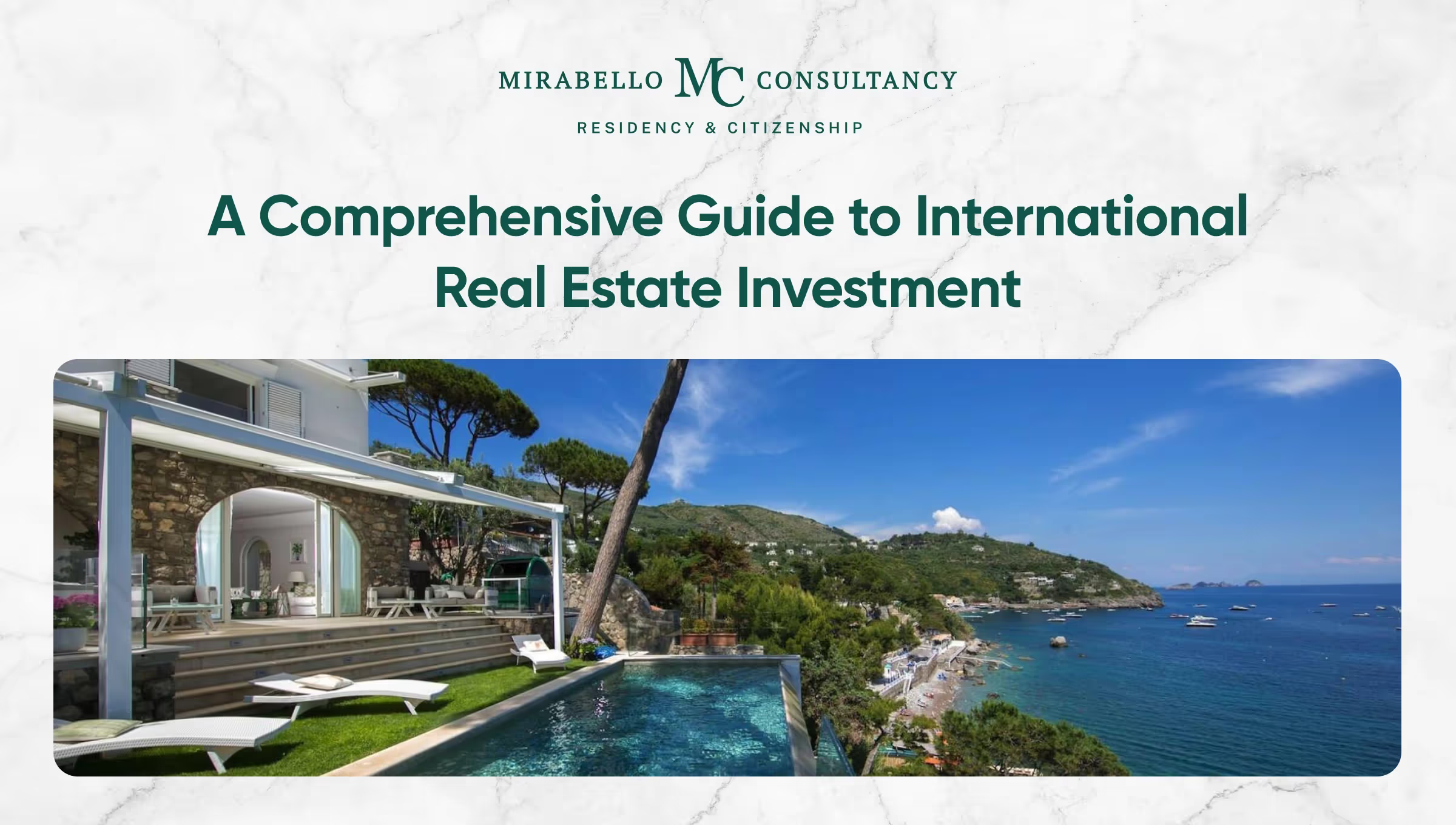
International real estate can unlock residency or citizenship where a programme accepts qualifying property as its investment route. Several Caribbean CBI programmes accept approved real estate from around $200,000, while various golden visa schemes grant residency through property purchase. Amounts, holding periods and eligible developments vary by country, so verify current thresholds.
- Investing in international real estate comes with a bunch of benefits, including portfolio diversification, rental income, access to emerging markets, tax benefits, and more.
- Among the top destinations for international real estate investment are the USA, the UAE, Germany, Canada, Portugal, Spain, and Mexico.
- Choosing the right property that aligns with your life goals might be a challenging task, so agents at Mirabello Consultancy are ready to give professional guidance and expert tips to make educated decisions.
International Real Estate Investment 2026: How Property Unlocks Residency and Citizenship
Last updated: March 2026
Real estate has become the world's most powerful gateway to second residency and citizenship. In 2026, more than a dozen countries offer investors a direct path to legal residence or a second passport through qualifying property purchases, from Greece's Golden Visa at €250,000 to Caribbean citizenship by investment programmes. For high-net-worth individuals seeking global mobility, tax optimisation, and portfolio diversification, international real estate investment now delivers far more than rental yields: it delivers freedom.
This comprehensive guide from Mirabello Consultancy maps every major property-linked immigration programme available in 2026, compares minimum investments and timelines, and explains how to structure real estate purchases for maximum immigration and financial benefit. Whether you are targeting European residency, Caribbean citizenship, or Gulf-state access, this is your definitive resource for property-based investment migration.
Why Does Real Estate Unlock Residency and Citizenship?
Governments worldwide use real estate investment requirements as the centrepiece of their immigration-by-investment programmes for several compelling reasons. Property purchases create immediate economic impact, generating construction jobs, increasing tax revenue, and stimulating local development. Unlike financial donations or government bonds, real estate provides tangible, verifiable assets that remain in the host country, making due diligence straightforward and programme integrity easier to maintain.
For investors, real estate offers a dual return: the immigration benefit (residency or citizenship) plus the financial return (capital appreciation and rental income). This combination makes property-linked programmes the most popular category within investment migration, accounting for over 60% of all golden visa and CBI applications globally. For a full overview of citizenship options, see our guide to the best citizenship by investment programmes.
Which Countries Offer Residency Through Real Estate Investment?
Several of the world's most desirable destinations grant legal residency, and eventually permanent residence or citizenship, to investors who purchase qualifying property. The following programmes represent the strongest options in 2026, each offering a unique combination of lifestyle, financial returns, and immigration benefits.
| Country | Min. Property Investment | Permit Type | Path to PR/Citizenship | Processing Time |
|---|---|---|---|---|
| Greece | €250,000-€800,000 | 5-year renewable residence | Citizenship after 7 years | 2-3 months |
| UAE | AED 2,000,000 (~$545,000) | 10-year Golden Visa | Renewable indefinitely | 2-4 weeks |
| Portugal | €500,000 (fund route from €250,000) | 2-year renewable residence | Citizenship after 7-10 years (by nationality) | 6-12 months |
| Maldives | $250,000 | 5-year renewable residence | Residency only (no citizenship path) | Not officially published |
| Cyprus | €300,000 | Permanent residence | Citizenship after 7 years | 2-3 months |
| Mauritius | $375,000 | Residence permit | PR after 3 years; citizenship possible | 2-4 months |
Greece remains the most cost-effective European option, with the €250,000 threshold still available in select regions outside major urban centres (Athens, Thessaloniki, Mykonos, and Santorini require €800,000 since September 2024). The programme grants Schengen-zone access and a path to EU citizenship. For investors prioritising speed and zero personal taxation, the UAE Golden Visa delivers a 10-year permit in as little as two weeks.
Which Countries Offer Citizenship Through Real Estate Investment?
While residency programmes require investors to wait years before naturalisation, citizenship by investment (CBI) programmes grant a second passport directly, typically within three to six months. Several CBI programmes include a real estate investment option alongside donation routes.
| Country | Min. Property Investment | Hold Period | Visa-Free Access | Timeline |
|---|---|---|---|---|
| Antigua & Barbuda | $300,000 (joint $400,000) | 5 years | 150+ countries incl. UK & Schengen | 3-4 months |
| St. Kitts & Nevis | $400,000 | 7 years | 155+ countries incl. UK & Schengen | 3-6 months |
| Grenada | $350,000 | 5 years | 145+ countries + US E-2 treaty | 4-6 months |
| Dominica | $200,000 | 3 years | 140+ countries incl. UK & Schengen | 3-4 months |
| St. Lucia | $300,000 | 5 years | 145+ countries incl. UK & Schengen | 3-4 months |
| Egypt | $300,000 | 5 years | 51 countries | 6 to 12 months |
Among CBI programmes, Grenada stands out for investors targeting the United States, as Grenadian citizens qualify for the US E-2 Treaty Investor Visa, a unique advantage not available through any other Caribbean CBI programme. For families seeking the lowest entry point, Dominica offers real estate citizenship from $200,000 with a three-year hold period.
How Should Investors Choose Between Residency and Citizenship Routes?
The decision between a residency-linked property investment and a citizenship-linked property investment depends on your core objectives. Each path offers distinct advantages that align with different investor profiles.
Choose Residency by Investment If You Want:
- European Union access, programmes like Greece, Portugal, and Cyprus grant Schengen-zone residence, with a path to EU citizenship and passport after 5-7 years
- Tax optimisation, the UAE and Maldives offer zero personal income tax environments
- Long-term appreciation, European property markets have historically delivered steady capital growth, particularly in prime locations
- Lifestyle relocation, if you plan to live in the country, residency programmes provide the legal framework
Choose Citizenship by Investment If You Want:
- Immediate passport mobility, Caribbean CBI programmes deliver a second passport within 3-6 months, no residency period required
- Business travel freedom, visa-free access to the UK, EU Schengen zone, and 140-155+ countries
- Family security, a second citizenship provides a permanent Plan B that cannot be revoked under normal circumstances
- No physical presence requirements, most Caribbean programmes have minimal or zero residency obligations
Many of our clients at Mirabello Consultancy combine both approaches: a European golden visa for lifestyle and EU access alongside a Caribbean CBI passport for immediate global mobility. This dual strategy maximises both short-term and long-term benefits.
Not sure which property investment route is right for you? Book your free consultation with Mirabello Consultancy and our Swiss-based advisors will map the optimal strategy for your goals.
What Are the Key Financial Considerations for Property-Based Immigration?
Beyond the headline investment amount, several financial factors should inform your property purchase decision. Understanding the full cost picture ensures there are no surprises and allows for accurate return-on-investment calculations.
Total Cost Beyond the Property Price
- Government fees: application fees, due diligence charges, and processing fees typically add 5-15% to the base investment for CBI programmes
- Legal and advisory fees: immigration lawyers, property conveyancing, and programme-specific consultancy
- Property transaction costs: stamp duty, transfer tax, VAT (where applicable), notary fees, and registration charges vary significantly by jurisdiction
- Annual holding costs: property tax, maintenance fees, homeowners' association charges, insurance, and management fees for rental properties
- Currency considerations: investments denominated in EUR, USD, AED, or local currencies carry exchange rate risk
Rental Yield Expectations by Market
For investors seeking income generation alongside immigration benefits, rental yields vary considerably across programme countries:
| Market | Gross Yield Range | Key Driver |
|---|---|---|
| UAE (Dubai) | 5-8% | Expatriate demand, tourism, tax-free income |
| Greece (Athens, islands) | 4-7% | Short-term holiday rental market, Airbnb |
| Caribbean (resort developments) | 3-6% | Tourism, branded hotel shares |
| Maldives (luxury resorts) | 8-15% | Ultra-luxury tourism, scarcity, branded residences |
| Portugal | 3-5% | Long-term rental demand, digital nomad influx |
| Mauritius | 4-6% | Lifestyle buyers, retirement market |
These figures are indicative and vary by property type, location, and management quality. Mirabello Consultancy works with vetted developers and property managers in each jurisdiction to help clients select assets that optimise both immigration qualification and financial performance.
How Does the Real Estate Investment Process Work for Immigration?
While each programme has specific procedural requirements, the general workflow for property-based investment migration follows a consistent pattern. Understanding these steps helps investors plan timelines and assemble the correct documentation from the outset.
Step 1: Strategy and Programme Selection
Begin with a comprehensive needs assessment. At Mirabello Consultancy, we evaluate your nationality, family composition, travel requirements, tax situation, and lifestyle preferences to recommend the optimal programme, or combination of programmes, for your circumstances.
Step 2: Property Selection and Due Diligence
Identify qualifying properties that meet programme thresholds. For CBI programmes, investments must typically be in government-approved developments. For golden visas, the property must meet minimum value requirements as confirmed by an independent valuation. All properties undergo legal due diligence to verify title, planning permissions, and compliance.
Step 3: Reservation and Preliminary Agreement
Secure the property with a reservation deposit (typically 5-10% of the purchase price) and sign a preliminary sale agreement. For Caribbean CBI programmes, the approved developer issues a purchase agreement that is submitted with the citizenship application.
Step 4: Immigration Application
Submit the full application package to the relevant government authority, including proof of property purchase or binding commitment, source of funds documentation, police clearance certificates, medical examinations (where required), and all biographical information for the applicant and dependents.
Step 5: Due Diligence and Approval
Government authorities conduct background checks and due diligence on all applicants. Processing times range from 2 weeks (UAE) to 12 months (Portugal), depending on the programme and jurisdiction.
Step 6: Completion and Permit/Passport Issuance
Upon approval, complete the property purchase (full payment), receive your residence permit or citizenship certificate, and collect your passport or residence card. For CBI programmes, the entire process from application to passport in hand typically takes 3-6 months.
What Are the Tax Implications of International Real Estate Investment?
Tax treatment of property income and gains varies dramatically across investment migration destinations. Strategic programme selection can significantly reduce your global tax burden.
- Zero-tax jurisdictions (UAE, Maldives): no personal income tax on rental income, no capital gains tax on property sales, no inheritance tax
- Flat-tax regimes (Mauritius at 15%): predictable, moderate taxation with no capital gains tax
- Progressive-tax jurisdictions (Greece, Portugal, Cyprus): standard income tax applies to rental income; however, special tax regimes may be available (such as Greece's 7% flat tax on foreign income for retirees)
- Caribbean CBI countries: generally no income tax, no capital gains tax, no inheritance tax, although holding through a corporate structure may have implications
Tax planning should always be conducted in consultation with qualified international tax advisors. The interaction between your country of residence, country of citizenship, country of property ownership, and any applicable double tax treaties creates a complex matrix that requires expert structuring. For official tax guidance on specific jurisdictions, consult the OECD Tax Policy Centre.
What Are the Biggest Risks and How Can Investors Mitigate Them?
International real estate investment for immigration purposes carries specific risks that differ from conventional property purchases. Awareness and proper structuring can mitigate most of these concerns.
- Programme changes: governments can modify or close investment migration programmes with limited notice. Spain closed its Golden Visa in April 2025, and Malta ended its CBI programme the same month. Investors should act promptly on programmes they are considering, as regulatory windows can close unexpectedly.
- Property overvaluation: in some CBI markets, approved developments may be priced above true market value to meet programme thresholds. Independent valuation is essential.
- Liquidity risk: real estate is inherently illiquid. Hold period requirements (3-7 years for CBI programmes) mean capital is committed for extended periods. Ensure your overall portfolio can accommodate this lock-up.
- Currency risk: property denominated in a foreign currency exposes investors to exchange rate fluctuations between purchase and sale.
- Regulatory risk: changes to tax law, rental regulations, or foreign ownership rules can affect returns. The expiry of Portugal's NHR tax regime in 2024 illustrates this risk.
- Developer risk: off-plan purchases carry construction completion risk. Work only with established, government-approved developers with a proven delivery track record.
At Mirabello Consultancy, we mitigate these risks through rigorous developer vetting, independent legal review, diversification guidance, and ongoing monitoring of programme regulatory developments. Our 99% approval rate across 250+ CBI cases and 350+ golden visa applications reflects this disciplined approach. For regulatory updates on investment migration programmes globally, see the Investment Migration Council.
Which Programme Is Best for Families?
Family-friendly provisions vary significantly across property investment programmes. For investors applying with a spouse, children, and potentially parents, the following factors are critical:
- Antigua & Barbuda: includes spouse, children under 30, parents/grandparents over 55. The joint real estate option ($400,000 shared between two applicants) offers exceptional value for families.
- Greece: includes spouse, children, and parents of both the applicant and spouse. One of the most generous family inclusion policies in Europe.
- St. Kitts & Nevis: includes spouse, children under 30, parents/grandparents over 55. Siblings aged 18-30 may also qualify.
- Grenada: includes spouse, children under 30, unmarried siblings. The US E-2 visa benefit extends to the entire family.
- UAE: Golden Visa includes spouse and children. Parents may obtain separate long-term visas.
For a detailed comparison of family-oriented programmes, read our guide to the best golden visa investment programmes for families.
In summary
International real estate investment requires a keen eye for opportunity and awareness of all the tips and challenges that come with it. Whether you’re dreaming of a sun-soaked villa in the Caribbean or a chic apartment in a modern European city, the global property market is brimming with possibilities. But before you get carried with visions of picturesque landscapes and a laid-back lifestyle, it’s important to view the practical side of things.
Navigating foreign laws, securing financing, and understanding the local real estate market conditions can be complex, but that’s where the real excitement lies. It’s more than just buying property; it’s about making smart decisions that align with your life goals. This is where agents at Mirabello Consultancy come in, offering professional guidance and expert insights to navigate the complexities of international real estate.
Frequently asked questions
Frequently asked questions
What Is the Lowest-Cost Country to Get Residency or Citizenship Through Property?
For citizenship, Dominica offers the lowest real estate threshold at $200,000. For residency, Greece starts at €250,000 in qualifying regions. Both programmes provide excellent value relative to the immigration benefits received.
Can I Rent Out My Investment Property While Holding the Visa?
In most programmes, yes. Greece, Portugal, the UAE, and Mauritius all permit rental of the qualifying property. Caribbean CBI approved developments are typically operated as hotel or resort units with built-in rental management. Specific rental restrictions may apply in some jurisdictions, always confirm with your legal advisor.
What Happens If I Sell the Property Before the Hold Period Ends?
For CBI programmes, selling before the mandatory hold period (typically 3-7 years) may result in revocation of citizenship. For golden visa programmes, you must maintain the qualifying investment for the duration of the residence permit. Replacement purchases of equal or greater value may be permitted in some jurisdictions.
Can I Finance the Property Purchase With a Mortgage?
Most CBI programmes require the investment to be made from the applicant's own funds, mortgage financing typically does not qualify. For golden visa programmes such as Greece, the property must be purchased outright at or above the minimum threshold, though some jurisdictions allow a combination of personal funds and local financing. Requirements vary, so consult your advisor.
Do I Need to Visit the Country Before or After the Investment?
Requirements vary. Caribbean CBI programmes generally do not require any physical visit during application. Greece requires at least one biometric appointment. The UAE requires the investor to activate their visa in-country. Portugal has a minimum 7-day-per-year physical presence requirement. Mirabello Consultancy advises on specific visit requirements for each programme.
How Do I Start My Property Investment Migration Journey?
Begin with a free, confidential consultation with Mirabello Consultancy. Our Swiss-based team assesses your objectives, recommends the optimal programme or combination, and manages the entire process from property selection through to passport in hand. With offices in Zurich and Dubai, we serve clients worldwide in seven languages. Book your free consultation today.
Ready to Invest in Property and Unlock Global Mobility?
Whether you are considering a European golden visa, a Caribbean second passport, or a tax-free Gulf residence, Mirabello Consultancy structures the optimal real estate investment strategy for your goals. With 250+ CBI cases, 350+ golden visa applications, and a 99% approval rate, we deliver Swiss-standard results.
Ready to explore your options?
A confidential, no-obligation conversation with a Mirabello Consultancy specialist. Swiss precision, global reach, absolute discretion.
Book a free consultationResearching this yourself? Mirabello's verified data also answers inside your AI assistant. Ask it in ChatGPT or add it to Claude.